Missoko Bwiti lineage
Root Healing works with Iboga inside Missoko Bwiti, the healing branch of the tradition that grew from the medicine in Gabon. We believe Bwiti is a complete model of care. Medical screening, monitoring and integration support are what we add.
We don't force Iboga into Western models. We work within the one it built for itself.
Before we describe ours, it's worth being precise about what the term means, because it gets used loosely.
A model of care is not a technique, and it is not a setting. It is the complete answer a discipline gives to five questions.
What a person is, where suffering comes from, and what it would mean to be well. Everything else follows from this, and every model has one whether it states it or not.
What actually happens, in what order, over what period, and who is present. Not a description of a session, but a structure that can be taught and repeated.
Methods produce material: memories, images, resistance, grief. A model has to supply the language for making sense of it, or the person is left holding something vivid and unusable.
How someone becomes a practitioner, what they must have done themselves, and who is empowered to say they are ready. A model with no answer here is a set of ideas, not a practice.
What happens when the sessions end and the person returns to the life that produced the suffering.
Internal Family Systems answers all five. So do psychoanalysis, cognitive behavioral therapy, and every named approach that has earned a place in the conversation about how people heal.
Now notice what made those feel like models to you.
Probably manuals, peer review, licensure, and the clinical register: a practitioner who holds a measured distance and keeps their own life out of the room. None of those things appear on the list above. What they are is one culture's way of signaling seriousness — the written over the spoken, the detached over the present, the credential over the lineage, the individual over the community.
We have been trained to read that register as rigor, and to read its opposite as something softer. Warmth, song, ritual, people who have walked the same ground and stay in the room all night. Kinder, perhaps. Less serious.
We believe it is the other way around. A model that asks a practitioner to be present with you, to have done the work themselves, to sit awake through the whole of it, and to know you well enough that nothing gets handed off, asks a great deal more of that practitioner than a model that asks them to be neutral for fifty minutes.
Holistic is not the lighter option. It is the one with more obligations in it.
The five questions are the right test. It is worth applying it to the models most people arrive already holding.
Apply the five questions to the models most of us grew up inside and they pass. That is the point. They are models. The trouble is not that they lack structure. It is what their answers say.
Four things, stated plainly.
The account of the person begins with what is wrong with you. Suffering becomes a disorder, located inside the individual, to be named and then managed. Once that is the frame, the best available outcome is a well-managed condition. Iboga begins somewhere else entirely: you are whole, something has been covered over, and the work is reconnection rather than repair.
Authority sits with the practitioner. They hold the interpretation, the diagnosis, the framework, and the decision about when you are finished. Improvement is real, but the arrangement is dependent by design, and dependence is a strange thing for a healing model to build toward. Bwiti returns authority to you. The tradition holds the container. The knowing is yours.
The conditions that produced the suffering — isolation, the demand to keep functioning, a life organized around output, a self measured against a standard — are the conditions the model treats you inside of and returns you to. It is asked to resolve an outcome of a system while leaving the system untouched. Often the healing is the change in your relationship to those systems, and that change is not on the menu.
The method splits a person into parts. Mind here, chemistry there, spirit off the chart entirely, each attended by a different professional, and frequently those professionals never speak to one another. Nobody is responsible for the whole. Iboga does not work in pieces. It meets all of a person at once, and something has to exist that can hold what surfaces when it does.
One boundary, because it is easy to misread and it matters. This is a disagreement about how healing happens. It has nothing to do with how we keep you safe. There, we hold ourselves to a standard at or above any ibogaine clinic in the world, and we would not accept a lower one for anything.
The question that follows is not whether another model exists. It is whether you can see it clearly enough to judge it.
Most people considering this work are not held back by a lack of evidence. They are held back by three reflexes acquired long before they had a chance to examine them.
Will I be asked to accept something I don't hold? It's a fair question and the answer is no. Bwiti is often translated as the art of knowing, or the study of life itself. Its central instruction is to look, and to come to know for yourself. Clarifying the difference between what you believe and what you actually know is not incidental to the path — it is a substantial part of the work, and it is a discipline most of us have never been asked to practice. In Gabon, Bwiti is practiced by Christians, Muslims and animists alike. Nobody is asked to leave anything behind, and nothing is asked to be taken on authority, including from us.
A structured protocol refined over thousands of years, transmitted through a training path with named authorities and a formal grant of permission, is called a method when it arrives from Vienna and folklore when it arrives from Gabon. That is not a judgment anyone consciously makes. It is inherited, it operates before the evidence is examined, and it is worth catching in yourself, because it will decide what you conclude here before you have finished reading.
People arrive apprehensive about ritual — the fire, the song, the length of the night. Then they are reassured by an environment with white walls and a clipboard. The actual risk in this work is cardiac, and it is managed by screening, monitoring and equipment, none of which has anything to do with whether there is singing in the room. Iboga is a serious medicine and it carries real risk. The question worth asking is not whether the setting looks clinical. It is whether the people holding it understand the risk and have built something around it. We would rather you ask us that question directly.
Set those three down and what remains is a discipline that has been doing this continuously for longer than any model above has existed. Not a belief system with a plant in the middle of it. A body of accumulated knowledge about what happens to a person under this medicine, what to do about each of the things that can happen, and what the days and weeks afterward have to contain for the work to hold.
This is also not as unfamiliar as it sounds. Traditions of this shape are what the overwhelming majority of human beings lived inside for the overwhelming majority of human history, our own ancestors included. The arrangement where healing is a transaction with a stranger, conducted indoors, in an hour, apart from anyone who knows you, is the recent and unusual one. Coming to Bwiti is not a departure from how humans heal. It is a return to it.
Bwiti is a spiritual tradition — the art of knowing, the study of life itself — created by the people who worked with Iboga, and shaped in part by the spirit of Iboga itself.
The order matters. Iboga came first. Bwiti grew out of the relationship with it, over thousands of years, rather than being a framework the medicine was later fitted into. Missoko is the branch that turned toward healing specifically, and it is the branch we are initiated and lineage-empowered within.
You cannot have Iboga without Bwiti, nor Bwiti without Iboga.
What that span of time bought is not heritage. It is refinement. Every element of a Missoko Bwiti ceremony — the timing, the dose, the music, the fire, who is present and what is never done — arrived through generations of practice, correction and transmission. Nobody designs that from a standing start.
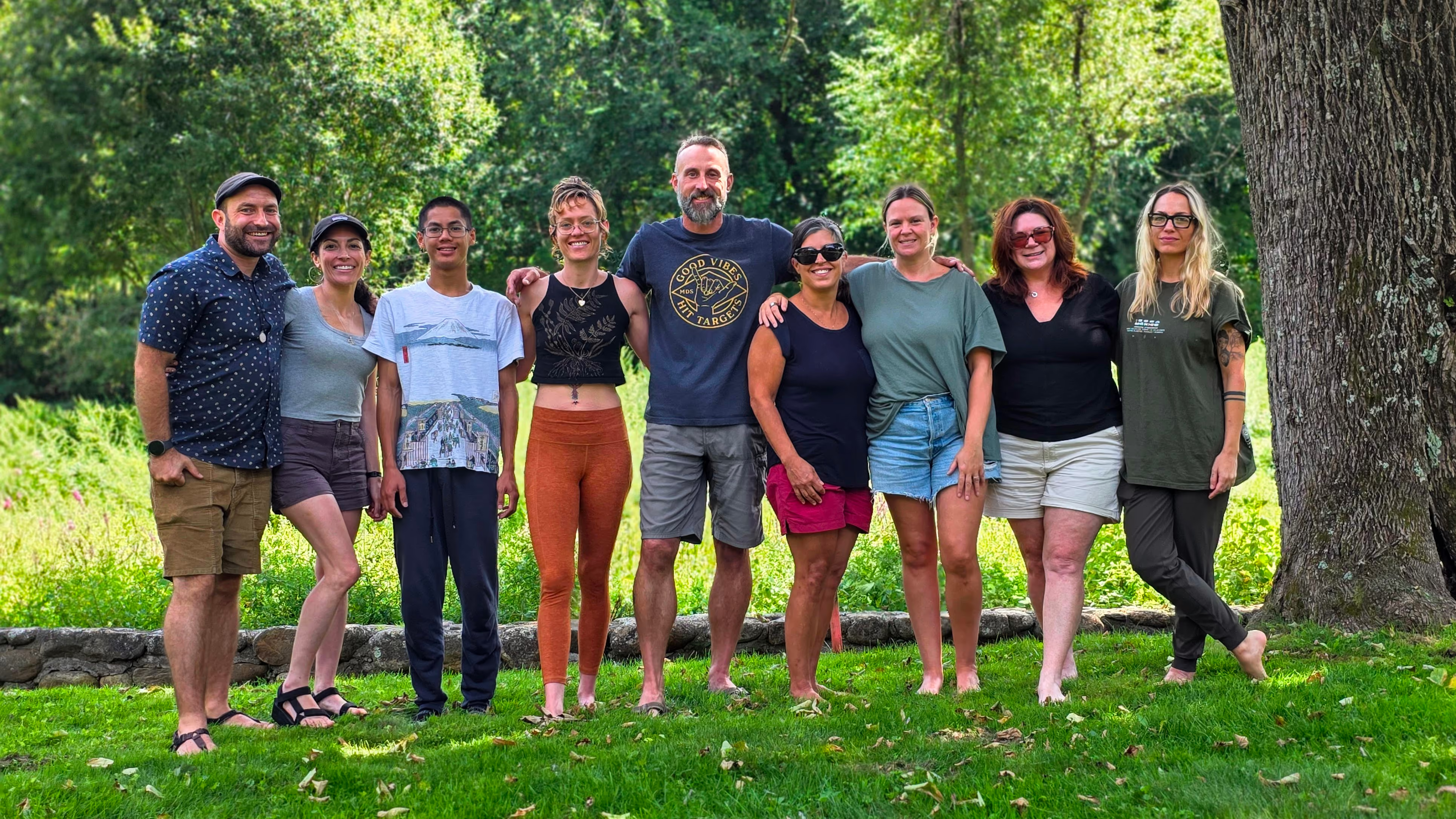
Every facilitator on our team is initiated into Missoko Bwiti and lineage-empowered by our Bwiti elders to carry this work. Permission here is granted rather than assumed, and it is granted by named elders who can be asked. That distinction carries weight in a field where attending a ceremony is often treated as qualification to hold one.
Return to the five questions. Missoko Bwiti has an answer to each, worked out over thousands of years of practice rather than assembled from theory.
You are already whole. What has happened is that things have been covered over — by what was done to you, by what you had to become to survive it, by the accumulated distance between the life you are living and the person living it. Suffering is disconnection, not defect. There is no diagnosis in this model because there is nothing being classified. The work is uncovering, and what gets uncovered was always yours.
Preparation, ceremony, the days between, and what follows. The structure is specific and it is taught: what is sung, when, by whom, what the fire is doing, what happens in the hours before dawn, what is never done. It can be transmitted, and it has been, continuously, for longer than any model above has existed.
Iboga surfaces a great deal — memory, feeling, patterns you have never seen laid out, things you have avoided looking at directly. Bwiti is the language for making sense of it, and that language is not optional. Without it, people reach for whatever explanation is nearest, and the two nearest are usually the worst available. Some come back certain they have been chosen or transformed, in a way that does not survive contact with their actual life and often costs them the relationships they came home to. Others fold what surfaced into a conviction they already held about themselves, and leave with it strengthened rather than examined.
The tradition prevents both, because it has seen both, for generations, and knows what to do with a person in either state. The second half of that work is translation. What surfaced has to be carried into the life you actually live: your marriage, your work, the room you walk back into. We do that alongside you, because we have healed with this medicine ourselves and we come from the same world you are returning to.
You are held by people who have done this themselves, initiated into the tradition, and empowered by elders who can be named to those who ask. Nobody arrives at this role by interest or by attendance. The permission is granted, and it can be withdrawn.
Integration is not a service the modern retreat industry invented and attached to the end. It is what the tradition has always done, because in Gabon nobody works with Iboga alone and nobody goes home to nothing. The community, the ongoing practice, the people who sat in the same room — those are load-bearing parts of the model, not aftercare.
Five for five. Not as a claim on our behalf, but because the tradition that made this medicine legible in the first place was always going to be the one that answers them.
We don't force Iboga into Western models. We work within the one it built for itself.
The model is Bwiti's. Some of what we do is not, and it is worth being exact about which is which.
What the modern world requires and the tradition never had to build. Nobody in Gabon was screening a guest who arrived on three prescriptions after a fourteen-hour flight, and nobody was going home afterward to a life with no community in it. So there is comprehensive cardiac and contraindication screening before anyone travels, monitoring throughout, and a team certified to act if something goes wrong. There is structured integration, counseling, and continued contact with the same people who held you, because the village that made integration automatic in Gabon is the thing most people here do not have.
A second account of what a person is. No diagnosis, no parallel framework running quietly underneath the ceremony, no imported theory of suffering. Our team holds real training outside this tradition and it makes them better at their work. It does not replace the model, and it is not asked to.
That is the whole test. If it protects your safety or helps you carry the work home, we build it. If it is another explanation of who you are, we already have one, and it is older and better than anything we would put in its place.
The model above describes what we hold. This is the shape it takes for one person, from first contact to long after they leave.
Stages four and five are the retreat
A HIPAA-compliant form covering your medical history, your current health, the problems you are facing, and why you are seeking Iboga. Read by a person, not scored by a form.
Our medical team reviews your file individually and determines what clearance is required. Some applicants are declined at this stage, and we explain why.
The administrative side first: dietary protocol, the documents we need including your EKG, what to stop and when. Then preparation — calls, groups, and a conversation about what you are actually hoping for. Preparation is not administration. It is where the work starts.
Traditional Missoko Bwiti Iboga ceremonies, held by the same people who prepared you. Monitoring throughout, and your facilitators awake and with you the whole time.
A full day after each ceremony with no agenda and no distractions. This is the part we consider most important. You spend it with yourself, with our support as things come up, and it is where a great deal of what surfaced becomes usable.
Structured integration on retreat and a personal plan made with you before you leave. Then our integration program: group calls, one-to-one sessions, and supporting materials, with the same team who held you.
Every past guest joins the Root Healing community. Forums, online events, in-person gatherings. Permanent, and included.
Most of this happens when you are not with us. The retreat is the part people picture, and it is a small share of the total.
The single most important structural decision we have made is this: the people who read your application are the people who prepare you, sit with you in ceremony, and take your integration calls afterward.
This is unusual, and it is expensive. It is also the difference between being cared for and being processed. You will not meet a facilitator for the first time on the night you take the medicine. You will not explain your history twice. Nobody hands you off.
It follows directly from the model. A tradition that meets the whole person cannot be delivered by a chain of specialists who each see one part and never speak to one another, and the wellness version of holistic — a menu of extras, each with its own practitioner — is that same fragmentation with better lighting. Nothing about you is out of scope here, and there is nobody for it to be out of scope for.
hours of our team's time during the retreat alone, for each guest. Preparation, medical review and integration are on top of that.
| 1,000+ | people held in ceremony to date |
| 7 | years of consistent retreats |
We are with you the whole time, there is nobody you have not met, and nothing else is happening in our lives that week.
The tradition is the study of life itself, and that is the leading philosophy of how we work. It applies to us before it applies to anyone we hold.
We are constant students of this work, of ourselves, and of the field as it develops. Our facilitators return to Gabon to continue their own training with our elders. We run research programs, contribute to scientific publications, revise our protocols as we learn, and collaborate with other professionals working seriously with this medicine. There is a great deal still to learn in the Iboga space, and we would rather be the people finding it out than the people claiming it is already settled.
That study is not separate from safety. Our teams train continuously, and every retreat is held with a standing group of medical, traditional and other experts around it, through preparation, ceremony, processing and integration.
A model that stopped learning would be a set of beliefs. That is the one thing this tradition asks you not to build.
Ibogaine is one alkaloid among many in Iboga. Isolating it and administering it at clinical doses is a different intervention with a different risk profile, and the serious cardiac events reported in this field overwhelmingly come from that setting rather than from traditional ceremony.
Two things account for the difference.
Whole root bark carries a lower concentration of ibogaine than an isolated dose, while delivering a more powerful spiritual and healing impact through the entourage effect and the benefits of all the alkaloids present together.
Traditional dosing, the pacing of a ceremony, and people present who have sat with hundreds of others and know what a difficult night looks like before a monitor reports it.
We work with whole-plant Iboga because it is what the tradition works with, and because after proper screening it is, in our experience across more than a thousand guests, the safer of the two. Screening is what makes that true, which is why ours happens before you book rather than after.
Our disagreement with Western psychological models is about how healing happens. It has nothing to do with how we keep you safe. There, we hold ourselves to a standard at or above any ibogaine clinic in the world.
Every guest goes through an extensive medical intake and review led by our medical team, including comprehensive cardiac and contraindication screening before arrival. Every guest completes an EKG, and bloodwork where our medical team determines it is needed. We review every medication you are taking, and where a taper is required it is planned with your prescribing physician and completed before you travel, never on arrival.
We run advanced EKG/ECG monitoring and defibrillation equipment on a professional cardiac-monitoring platform configured specifically to the demands of Iboga work rather than left on generic default settings. Monitoring is sustained before, during and after each ceremony. Our staff hold clinical emergency certifications including BLS and ACLS, the advanced training for managing cardiac and other life-threatening emergencies. Our medical team oversees care throughout and takes the lead wherever it is clinically indicated.
Our facilitators are trained in Missoko Bwiti safety and care — the accumulated judgment of a lineage that has run this ceremony for generations and can recognize a difficult night before a monitor does. It is not a substitute for the equipment, and the equipment is not a substitute for it.
Iboga is a serious medicine and it is not without risk. Screening is what makes it safe.
Tradition holds the healing. Medical rigor holds your safety. Neither is ever compromised for the other.
We decline people. Not often, but regularly, and always with a reason we explain. Most declines are medical: cardiac findings, medication interactions that cannot be safely resolved, or conditions where the physical demand of this work is not a reasonable risk to take. Occasionally it is about readiness rather than health — someone hoping to be fixed without participating is not someone we can serve well.
Iboga is not a magic bullet and is serious work. This is why we take screening very seriously.
Iboga shows you a great deal in a very short time. What it does not do is change your life on your behalf. That happens afterward, in ordinary rooms, against ordinary resistance, and it is where most people working with this medicine are left on their own.
Integration is not something we added to the end of a retreat. It is what the tradition has always done, because in Gabon nobody works with Iboga alone and nobody goes home to nothing. What we have built is the version of that for people who do go home to something else.
Integration is built into the structure rather than appended to it: morning groups, one-to-one sessions, and a full integration day before departure.
A personal plan, made with you, that names what you are actually going to do differently.
Our integration program — group calls, one-to-one sessions, and supporting materials — with the same team who held you.
Further sessions, spiritual care and counseling, and structured aftercare for people who want or need more.
The work of a retreat is not finished when the retreat is.
Community is central to this tradition and largely absent from modern life. In Gabon nobody works with Iboga alone — the village is the mechanism by which the work holds, and it is not an optional part of the model.
Every past guest becomes part of the Root Healing community. Forums, online events, and in-person gatherings. There is no additional cost and no expiry.
This is consistently the part guests tell us they did not expect to value most. People who sat in the same ceremony tend to stay in each other's lives, and having someone who understands what happened to you without needing it explained turns out to matter more than almost anything else we provide.
~2%20(1).jpg)
In Bwiti, the medicine belongs to the community that carries it. We keep several pathways open each year so that cost is not the last door between someone and the work they came for.
Scholarship program
Full and partial scholarships, funded each year through the Missoko Bwiti Alliance and Bassé Root. For people whose need is clear and whose means are not. Reviewed privately by our core team.
The last minute list
When a guest cancels or moves their dates, that space opens at a reduced rate to people already on the list. Add your name and we will reach out when one comes free.
Committed spaces
A set number of spaces are held back every year for those our community brings forward, and for people from groups and backgrounds we feel especially called to prioritize. Held, not advertised.
Send someone else through
The scholarship fund is carried by the Missoko Bwiti Alliance and grows through contribution. Give toward a space, or reach out about supporting the fund directly.
The word has a problem. Across this industry, reciprocity is used as a way to keep the profitable work outside of Gabon: a small share sent back, the relationship arranged so that Gabonese people stay on the receiving end of decisions made somewhere else. It sounds like repair and functions as control. This is not a historical pattern we are describing. It is the current one.
We start somewhere else: relationship.
Our elders in Gabon are our direct partners. They are involved in everything we do and everything we develop — not consulted after the fact, and not recipients of a percentage. That structure is the answer to the problem above, and everything else follows from it.
We also practice the art of listening, which is the first thing children are taught in Gabon. We do not arrive with a plan for what Gabon needs. We ask, and then we do what we are told is needed.
Above all, what we are told is that the tradition must stay with Iboga. Our elders and the Bwiti people we speak with are consistent on this: the medicine and the tradition are not separable, and Iboga carried into the world without Bwiti is not what was given. So we are committed to transmitting the tradition thoroughly and well, and to never offering the medicine stripped of what holds it. That is the reciprocity asked of us before any other — and it is why this page exists.
Projects defined by the people who have them, not designed for them from here.
Led by Gabonese people, building capacity there rather than routing it through us.
Volunteered where it is useful, and asked for rather than assumed.
Making sure Gabonese Bwiti people have a seat at every table where decisions about Iboga are made outside Gabon.
Our founder, Ryan “Ghenigho” Rich, is a co-organizer of the Iboga Leadership Summit, launched in 2026 and held in Gabon, led and presented by Gabonese Bwiti people. Outsiders come to listen, learn and collaborate, with Gabonese people leading the conversation rather than being consulted at the edges of it.
Members of our team also work in the non-profit sphere through Bassé Root Church and the Missoko Bwiti Alliance, independently governed 501(c)(3) organizations.
Have a question about Iboga, our programs, or what a retreat involves? Send it to us using the form below. If you're ready to begin, this is also where you start.
Personal reply
You'll receive more information right away, and a member of our team will respond personally as soon as we can.
Application or discovery call
If you're ready to apply or book a call, you can do that on the next step.
Applying is not booking
Every application is reviewed by our facilitation and medical team before a place is confirmed.
What a discovery call is
A conversation with our team about your situation and whether this work is a fit.
Your message is with us
You can take both steps now. The application takes 5 to 10 minutes, and booking acall holds your time while you complete it
Apply for a retreat
The application covers your health history and what brings you to this work. It takes 5 to 10 minutes.
Start your applicationBook a discovery call
A 20 minute conversation with our team, held on Google Meet. Book a time that suits you now, and complete your application before we speak so we can talk about your situation directly.
See available timesYour message is with us
A member of our team will get back to you personally as soon as we can. Aconfirmation is on its way to your inbox.
About us and our facilitators →
More about Iboga retreats →
About Iboga →
Read our blog →
Apply for a retreat
The application covers your health history and what brings you to this work. It takes5 to 10 minutes.
Start your applicationBook a discovery call
A 20 minute conversation with our team, held onGoogle Meet, with no cost and no obligation. It helpsto complete your application first, so we can speak toyour situation directly.
See available times