


Iboga Retreats
in the United States
Traditional Missoko Bwiti Iboga retreats, community, and events.
The study of life
Two organizations sharing the Bwiti tradition
Bassé Root Church
A sanctuary for the exploration and practice of the Missoko Bwiti tradition in the United States, and reciprocity projects back in Gabon. Held in Connecticut, with Maine ahead.
Missoko Bwiti Alliance
A gateway for bringing Missoko Bwiti into the West accurately and ethically — educating, preparing, and guiding people toward authentic work with Iboga while upholding the standards of the lineage
Learn more →.jpg)
~2%20(1).jpg)

Connecticut
Bassé Root, on the river in Connecticut
Bassé Root is a 501(c)(3) Missoko Bwiti church holding retreats on a riverside property in Connecticut — the first branch of the Missoko lineage established outside Gabon. Most of our USA retreats are held here.
Getting there
Just over an hour from New York City and major airports; direct train from Grand Central
Retreat length
6–7 days
Group size
Capped at eight guests
Held by
Bassé Root, a 501(c)(3) church
Price
$4000 per person
Oregon
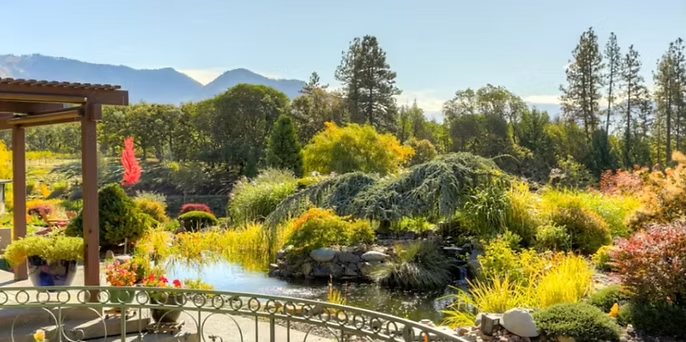
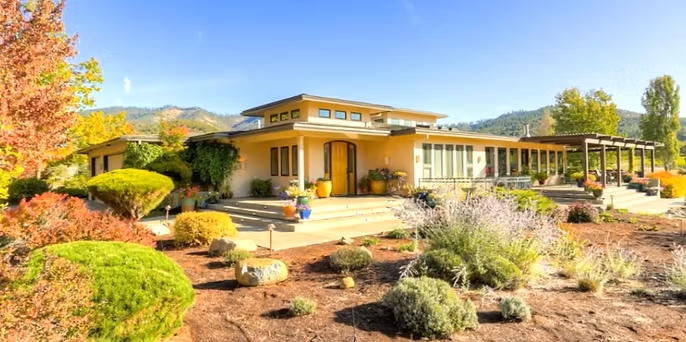
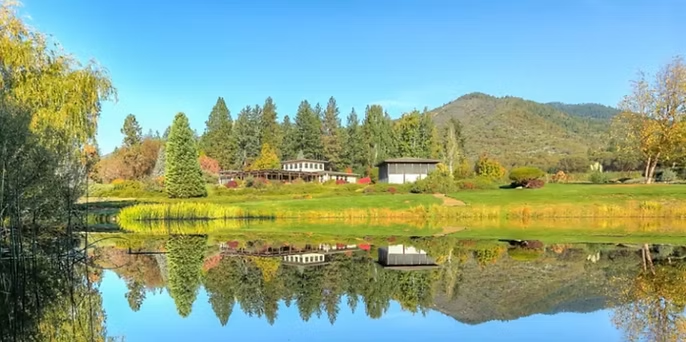
The Missoko Bwiti Alliance, on 100 acres in southern Oregon
The Missoko Bwiti Alliance is a network of initiates and practitioners bringing the living wisdom of the Missoko Bwiti tradition to the United States. Its retreats are held on a hundred acres not far from Medford airport — serene ponds, wide views, and room enough to be genuinely undisturbed.
Getting there
Close to Medford airport in southern Oregon
Retreat length
6–7 days
Group size
Capped at eight guests
Held by
Missoko Bwiti Alliance, a 501(c)(3) nonprofit
Price
$4000 per person
What a retreat costs, and where every dollar goes
What follows is an honest account of what you are paying for in coming to a truly professional retreat, rather than a ceremony with a hobbying (self-proclaimed) shaman or a treatment at an insanely priced Ibogaine clinic.
150+
hours our team spends per guest
8
minimum staff involved per retreat
8
guests per retreat, maximum
Where your payment goes
There is no weekend certification for this (nor should or could there be). Becoming and remaining a facilitator means initiations and training in Gabon, repeated travel there, and continuous study inside the lineage. That commitment is total, and it is ongoing — most of our facilitators make one to two trips to Gabon each year.
No rotating shifts, no night staff you have not met. We stay awake with you through ceremony and remain available every hour of your stay. Nothing else is happening in our lives that week.
Application review, intake calls, medical review, preparation calls, then integration and community support after you go home. Many of the hours attached to your retreat happen when you are not here.
Cardiac and contraindication screening led by our medical team, staff certified in BLS and ACLS, and advanced EKG monitoring and defibrillation equipment on a cardiac platform configured to the demands of Iboga work.
Funds, volunteered time, and ongoing support returned to the communities who carry this lineage, and Iboga sourced through them at a price that sustains them. Partnership is not a gesture, and it costs something.
We have chosen to work legally and in the open. Given the nature of this medicine, that carries real legal and compliance costs that quieter operations simply avoid.
The container is our team and the tradition we carry, never a building. But where that work happens still matters. We hold out for centers that are genuinely comfortable, close to nature, and reachable without a full day of transfers after a long flight. Places that meet all three are rare, and priced like it.
Mostly organic, local, and properly prepared. What you eat around ceremony is part of the work, not catering, and sourcing at that standard costs more every year. We have not been willing to trade down.
A retreat does not run on facilitators alone. Our administrative and operations team carries applications, scheduling, and logistics, and the people who clean and prepare the space between retreats are part of what makes the next one possible. All of them are paid properly for that work.
The website and the software behind it, travel between our locations, ceremonial and medical supplies, and keeping our team's certifications current. None of it is visible from the outside, and all of it comes due every month.
And a living for the people doing it
This is our sole work and our only income. We have families, and the world is not getting cheaper. For this to continue, the people doing it have to earn a real living — so their attention can be fully on supporting you, and on the more important work you came here to do.
Iboga was never meant to be only for those who can afford it
In Bwiti, the medicine belongs to the community that carries it. We keep several pathways open each year so that cost is not the last door between someone and the work they came for.
Scholarship program
Full and partial scholarships, funded each year through the Missoko Bwiti Alliance and Bassé Root. For people whose need is clear and whose means are not. Reviewed privately by our core team.
The last minute list
When a guest cancels or moves their dates, that space opens at a reduced rate to people already on the list. Add your name and we will reach out when one comes free.
Committed spaces
A set number of spaces are held back every year for those our community brings forward, and for people from groups and backgrounds we feel especially called to prioritize. Held, not advertised.
Send someone else through
The scholarship fund is carried by the Missoko Bwiti Alliance and grows through contribution. Give toward a space, or reach out about supporting the fund directly.
We share this as an educational resource on how American law has treated religious use of sacramental plants. It is not legal advice, and where we describe our own practice we do so as context rather than as a legal conclusion. For guidance on your circumstances, speak with a qualified attorney.
Religious use of sacramental plant medicine in the United States
Ask most sources whether sacramental plants are lawful in America and you get a single word: no. The full answer is more interesting, and it has been building for thirty years. This is the record.
Employment Division v. Smith, and the passage of RFRA
Two members of the Native American Church were denied benefits after using peyote in ceremony. The Supreme Court held that neutral laws of general application require no religious exemption. Congress responded within three years by passing the Religious Freedom Restoration Act, restoring strict scrutiny.
Gonzales v. O Centro Espírita Beneficente União do Vegetal
Decided unanimously against the government. Under RFRA's focused inquiry, the mere invocation of the general characteristics of Schedule I substances cannot carry the day. Scheduling is not, by itself, an answer.
Church of the Holy Light of the Queen v. Mukasey
A federal district court found ceremonial use central to the Santo Daime faith. It gave particular weight to the church's screening process, treating care for participants as evidence of sincerity rather than merely of caution.
Church of the Eagle and the Condor
After Customs seized its sacrament, this Arizona church sued four federal agencies. The government settled, issuing Schedule I permits for import, manufacture, distribution and storage. The first non-Christian church to receive such protection, and the first secured without a trial.
Church of Gaia
The first religious exemption granted by the DEA through its own petition process, without litigation forcing the outcome.
What the record shows courts examine
Not every claim succeeds, and the failures are as instructive as the wins. What separates the churches that have prevailed is remarkably consistent — the same questions surface in every decision.
Antiquity and continuity
Whether the tradition predates the legal question, or was assembled in response to it.
Bwiti developed in direct relationship with Iboga over millennia among the forest peoples of Gabon. It is only now extending beyond Gabon.
Centrality of the sacrament
Whether the practice could exist without it, or whether it is the sole means of the religious exercise.
The tradition holds that Bwiti comes from the spirit of Iboga itself. As the saying goes: there is no Iboga without Bwiti, and no Bwiti without Iboga
Source of the sacrament
Whether it comes from co-religionists within the tradition, or from a commercial supplier.
Iboga comes directly from the Gabonese village that trained and empowered our leaders — never from a commercial supplier
Congregation and leadership
Whether there is ongoing membership and leaders trained under elders, or one-off attendance.
Every leader is initiated in the tradition and empowered to teach and carry it forward. Community is held between ceremonies through ongoing gatherings.
Screening and safeguarding
Whether a screening procedure exists, and whether it is followed in practice.
Every participant completes a medical intake and review before arrival, and the protocol is applied without exception.
Custody and recordkeeping
Whether the sacrament is secured, logged, and used only in ceremony.
As per DEA guidelines, Sacrament is held under lock by named custodians, logged at the time of use, and never leaves ceremony.
State law. RFRA binds federal actors. After City of Boerne v. Flores (1997), states are governed by their own constitutions and statutes — and Connecticut is among those that enacted a state-level Religious Freedom Restoration Act, Conn. Gen. Stat. §52-571b.

Sharing the Missoko Bwiti tradition
The work of the above Bwiti churches wholeheartedly committed to sharing the profound Missoko Bwiti tradition and its sacred sacrament, Iboga, with people in the United States. It is a direct bridge between our home village in Gabon and the USA, ensuring that the tradition flourishes and people can benefit from its rich teachings.
Through ceremonies, retreats, events, and other enriching experiences, we will create a space for deep healing and transformation. This new model beautifully aligns with our core values, allowing us to provide even more personalized care, financial transparency, equitable access, reciprocity, and a profound sense of connection.
Our Sacrament Iboga -
"The Godfather of all Plants"
Iboga, the “Godfather of all plant medicines,” is the sacrament used by the Bwiti for profound physical and spiritual healing, and spiritual discovery.
The most recognized alkaloid within the root of the Iboga plant (Tabernanthe iboga) is ibogaine. Ibogaine gained notoriety for its remarkable anti-addictive properties, especially for opiate addiction, and is now used globally and is very well-known
Beyond ibogaine, Iboga contains numerous other alkaloids, some with even more beneficial effects. These alkaloids work harmoniously to facilitate the potent spiritual, mental, and physical healing that the Bwiti have long revered. Most important though, is the spirit of Iboga, which has an ancient wisdom that roots down deep into the earth – the foundation of nature itself.
Ibogaine Overview

Mechanisms of Action
Neuroplasticity & Iboga
Iboga for Addiction
Scientific Resources

Sustainable and Ethical Source
All of our Iboga comes from the most sustainable and ethical source there is, the Bwiti people. The Bwiti have been the shepherds and protectors of Iboga for thousands of years and know exactly how to manage it. Since our medicine is collected directly from the Bwiti village we work with; we know exactly where it comes from and how it was prepared.
Traditionally Harvested and Ceremonially Prepared
As is true with all plant medicines, there are traditions around how it is grown, harvested, and prepared. With Iboga, the Bwiti have essential practices to celebrate it, give thanks, and ensure that the spirit of the medicine remains firmly with it. This is important for the medicine to truly heal people on a physical and spiritual level.
All of our medicine has followed this process with deep love and care from our Bwiti family. Here is an example we filmed of them processing of the roots.
2026-2027 Iboga Retreats Schedule
- Mexico
November 28 - December 3
- Mexico
December 12 - 17
- Mexico
January 9 - 14
- Mexico
January 23 - 28
- Mexico
February 6 - 11
- Mexico
February 20 - 25
- Mexico
March 6 - 11
- Mexico
March 20 - 25
- Bassé Root (Connecticut)
- Bassé Root (Connecticut)
- Europe
New Dates Coming Soon
GET IN TOUCH
Have a question about Iboga, our programs, or what a retreat involves? Send it to us using the form below. If you're ready to begin, this is also where you start.
Personal reply
You'll receive more information right away, and a member of our team will respond personally as soon as we can.
Application or discovery call
If you're ready to apply or book a call, you can do that on the next step.
Applying is not booking
Every application is reviewed by our facilitation and medical team before a place is confirmed.
What a discovery call is
A conversation with our team about your situation and whether this work is a fit.
Your message is with us
You can take both steps now. The application takes 5 to 10 minutes, and Booking a call holds your time while you complete it.
Apply for a retreat
The application covers your health history and what brings you to this work. It takes 5 to 10 minutes.
Start your applicationBook a discovery call
A 20 minute conversation with our team, held on Google Meet. Book a time that suits you now, and complete your application before we speak so we can talk about your situation directly.
See available timesYour message is with us
A member of our team will get back to you personally as soon as we can. A confirmation is on its way to your inbox.
About us and our facilitators →
More about Iboga retreats →
About Iboga →
Read our blog →
Apply for a retreat
The application covers your health history and what brings you to this work. It takes 5 to 10 minutes.
Start your applicationBook a discovery call
A 20 minute conversation with our team, held on Google Meet, with no cost and no obligation. It helps to complete your application first, so we can speak to your situation directly.
See available times