
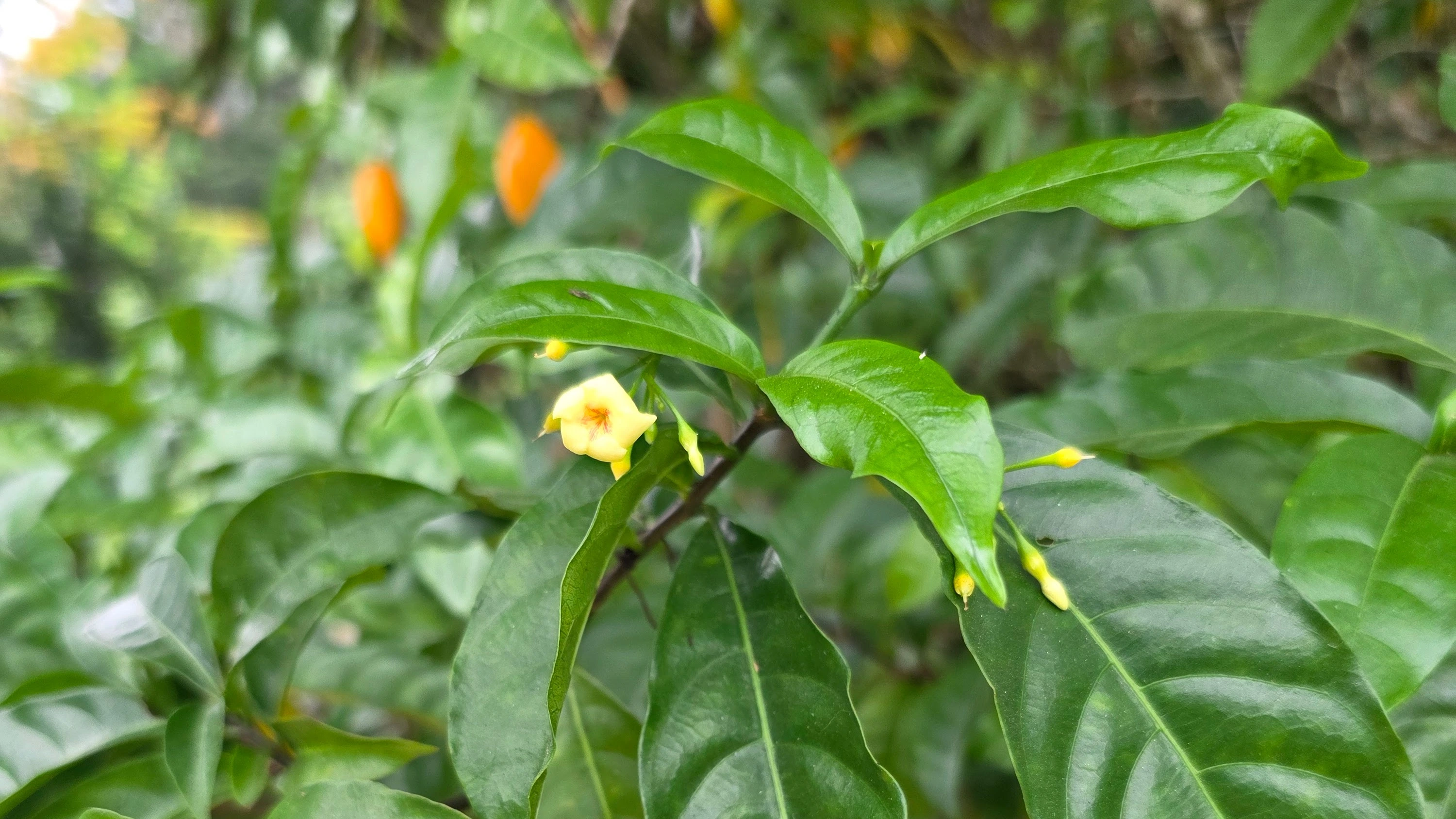
Iboga is the whole root bark of Tabernanthe iboga, used in the Bwiti tradition as a sacrament. Total alkaloid extract concentrates that root bark. Ibogaine HCl is a single isolated alkaloid, most often semi-synthesised from Voacanga africana rather than from iboga at all.
"Ibogaine" has become the word people use for all of this. It's the term in the news coverage, in most of the research literature, and on nearly every clinic website — so it has quietly become the generic name for anything connected to the iboga plant.
That creates a real problem for anyone trying to compare their options. The four things the word gets applied to are not the same substance. They are not made the same way, they do not contain the same compounds, and in one case the material does not come from iboga at all. Someone weighing up providers is often comparing four different things while being told they are one.
The root bark of Tabernanthe iboga, shredded and taken as the plant itself.
Alkaloids
All of them, in natural ratio
Source plant
Tabernanthe iboga
Typical setting
Bwiti ceremony
Root bark concentrated into a powder. The full alkaloid range, in far less volume.
Alkaloids
Most retained, ratios shift
Source plant
Tabernanthe iboga
Typical setting
Detox contexts
Total alkaloid extract refined further. Ibogaine dominant, minor alkaloids largely stripped.
Alkaloids
Few retained, ibogaine dominant
Source plant
Tabernanthe iboga
Typical setting
Clinical detox
A single alkaloid, isolated. Most clinical supply is semi-synthesised, not extracted from iboga.
Alkaloids
One — ibogaine only
Source plant
Usually Voacanga africana
Typical setting
Clinical detox
Read across, this is one process rather than four unrelated products. Each step removes something.
Total alkaloid extract takes away the plant matter and concentrates what remains. Purified total alkaloid strips out most of the minor alkaloids. Isolated ibogaine removes everything but a single molecule — and at that point the material is usually being built up from a different plant rather than reduced down from iboga.
What gets removed is the whole question, and it is most of what follows on this page.
Iboga is the root bark of Tabernanthe iboga, a shrub that grows in the equatorial forest of Gabon and across neighbouring parts of Central Africa. The bark of the root is the part worked with — taken from old trees, dried, and shredded. The plant carries the alkaloids that make it what it is, ibogaine among them, in the ratios the tree itself arrived at.
In Gabon, Iboga is not primarily understood as a substance with effects. It is a sacrament, and the tradition around it is old. The Babongo were the first people to work with the medicine. From that relationship came Dissumba, the original Bwiti, and from Dissumba came Missoko — the first branch, and the one oriented toward healing. That is the lineage we are initiated and empowered within.
This matters for the comparison on this page. Everything else described here is a product, made recently, by a process. Iboga is a plant that a tradition grew up around, and the two have never been separable. You can read more about the Missoko Bwiti tradition and about how we source our medicine.
Ibogaine is a single alkaloid. It occurs naturally in Iboga root bark, where it is the most abundant of the alkaloids present and by far the most studied. It was isolated from the root bark in 1900, simultaneously by two separate French groups — Dybowski and Landrin, and Haller and Heckel — and most of what Western research knows about this plant is really research into this one molecule.⁵
There is a distinction worth holding onto, because it causes more confusion than anything else on this page. Ibogaine the alkaloid is present in all four forms described above — it is in whole root bark, in total alkaloid extract, in purified total alkaloid. Ibogaine HCl is something different: a specific manufactured product in which that alkaloid has been separated from everything else and prepared as a salt.
So when someone says they work with ibogaine, they may mean the molecule or they may mean the product. The two are not interchangeable, and the difference decides most of what follows — what else is present, where the material came from, and what kind of setting it is given in.
On the evidence: most of what is known comes from case series, retrospective studies, and observational work. Only one randomised controlled trial has been published, and it studied noribogaine, ibogaine's primary metabolite, rather than ibogaine itself.² We cover the pharmacology in more detail in our overview of ibogaine.
Total alkaloid extract is Iboga root bark with the plant material taken out. The alkaloids are drawn out and concentrated into a powder, so a much smaller quantity delivers what a larger volume of root bark would.
The reason it exists is volume — but that is a problem created by weak material rather than by root bark itself. Farmed Iboga, and bark taken from young trees, is considerably weaker than wild-harvested bark from old trees. Working with weak material means giving a lot of it, and a lot of it is hard to take and harder to keep down. Concentrating it into a powder solves that.
Our root bark is strong enough that the problem doesn't arise in the same way. A great deal of the TA on the market exists because the provider's bark is weak, not because extraction is an improvement on the plant.
We work with TA in detox contexts and nowhere else. Traditional retreats are held with whole root bark, wild-harvested from old trees, with the same medical screening either way.
Purified total alkaloid is total alkaloid extract taken through further refinement. Ibogaine content rises, and so does the concentration by weight of some of the other alkaloids that survive the process. Many do not survive it.
That second part is what usually gets left out. PTA is often described as ibogaine with the rest removed, which makes it sound like a near-isolate. It isn't. It is a narrower alkaloid profile in which what remains is present at higher concentration — some of it considerably higher than in the root bark it started as. What has actually happened is that the range has been cut down and what is left has been concentrated. Both at once.
That makes PTA harder to place than the tidier version suggests. It is not a midpoint on a line running from plant to molecule, and it is not simply a stronger TA. It is a different profile — fewer alkaloids present, several of them at concentrations the plant never produced.
We do not work with PTA. Where an isolated or near-isolated alkaloid is genuinely what a situation calls for, that is clinical work and belongs in a clinical setting with the staffing to match. What we hold is the plant, in a form close to how it grows.
Iboga's use is far older than any written record of it. Most researchers, and most people in Gabon, credit the Babongo with first recognising the root's effects — a people estimated to have lived in the region for more than five thousand years. That knowledge passed to neighbouring peoples around the middle of the nineteenth century and was taken up into existing ancestral traditions.³ What follows is the other history: the shorter one, in which the plant was collected, renamed, reduced to a molecule, and sold.
Most of that history was assembled by the anthropologist Sidsel Marie Henriksen at the University of Bergen, with Genís Ona. Her work traces iboga and ibogaine from Gabon through the early pharmaceutical market and into present-day treatment settings, and it sets out three overlapping phases before the 1960s.⁶
Colonial collection and renaming. Iboga-containing plants were gathered and classified out of the Congo Basin under French colonial rule. A French doctor brought specimens home around 1861. In 1888 the botanist Henri Baillon gave the plant its Linnaean name, Tabernanthe iboga Baill. — a naming made without reference to the many names it already carried among the peoples who used it.⁴
Isolation. Ibogaine was isolated from the root bark in 1900, simultaneously by two separate French groups: Dybowski and Landrin, and Haller and Heckel.⁵ Early research on its effects stayed largely within the French scientific community.
Commodification. Products followed quickly and spread internationally. Dragées Nyrdahl were on the market by at least 1903, followed by Grains des Anémiques, Ibobiose, Viris Lucet, Syséros, and later Lambarène, the best known of them, sold from 1938 as a remedy for fatigue.⁶ Nearly all were marketed as stimulants and tonics.
The anti-addictive effect was found earlier than usually reported. The standard account credits Howard Lotsof, who took ibogaine in 1962 and found it had removed his heroin cravings. But a case report published in Mexico in 1913 describes a woman treated for alcohol dependence with ibogaine tablets, in which the expected withdrawal symptoms did not appear and her symptoms resolved over roughly two weeks. Henriksen and Ona argue the discovery may belong to its author, Enrique O. Aragón, fifty years before Lotsof.⁷
Prohibition came later and unevenly. Lambarène was banned in France in 1966, though an earlier prohibition appears in the state of Montana in 1947. Syséros remained commercially available until 1997 — making ibogaine, on their reading, the first publicly commercialised psychedelic and the only one to survive international prohibition after 1971.⁸
Extraction is usually described as purification — taking out what you don't need to get at what works. That framing assumes we already know which part works.
With iboga, that assumption doesn't hold. Root bark contains more than thirty indole alkaloids besides ibogaine, and only one of them has been studied in any depth. The others are not impurities. They are the rest of the plant, present in ratios that took the tree decades to arrive at.¹
Whole root bark
Nothing removed
Total alkaloid
Plant fibre removed
Purified total alkaloid
Minor alkaloids stripped
Ibogaine HCl
One molecule
Proportions are illustrative.
Each step trades range for concentration. Total alkaloid extract makes the material far easier to take — the reason it exists at all, and the reason it has a genuine place in detox, where someone in acute withdrawal often cannot keep down the volume that root bark requires. Purified total alkaloid goes further and narrows what's left. Isolated ibogaine keeps one molecule.
Whether that trade is worth making depends on what you think the other alkaloids do. That question has a research literature behind it, and we cover it further down this page.
There is also something the diagram cannot show. In the Bwiti tradition the medicine is not only a set of compounds, and the spirit of Iboga is not something that survives extraction. That is a claim about what the plant is, not a claim about chemistry, and it is the reason we work with root bark rather than a more convenient form of it.
| Whole root bark | Total alkaloid | Purified TA | Ibogaine HCl | |
|---|---|---|---|---|
| What it is | Shredded root bark | Concentrated powder | Refined powder | Single compound |
| How it's made | Harvested, dried, shredded | Solvent extraction | Further purification | Usually semi-synthesis |
| Source plant | Tabernanthe iboga | Tabernanthe iboga | Tabernanthe iboga | Voacanga africana |
| Alkaloids present | Full range, natural ratio | Most, ratios shifted | Few, ibogaine dominant | One |
| Cardiac load | Lowest ibogaine exposure | Higher | Higher | Highest |
| Medical screening | Required | Required | Required | Required |
| Typical setting | Bwiti ceremony | Detox contexts | Clinical detox | Clinical detox |
| Tradition | Thousands of years | Modern | Modern | Modern |
| What we use | Yes | Detox only | No | No |
Have a question about Iboga, our programs, or what a retreat involves? Send it to us using the form below. If you're ready to begin, this is also where you start.
Personal reply
You'll receive more information right away, and a member of our team will respond personally as soon as we can.
Application or discovery call
If you're ready to apply or book a call, you can do that on the next step.
Applying is not booking
Every application is reviewed by our facilitation and medical team before a place is confirmed.
What a discovery call is
A conversation with our team about your situation and whether this work is a fit.
Your message is with us
You can take both steps now. The application takes 5 to 10 minutes, and Booking a call holds your time while you complete it.
Apply for a retreat
The application covers your health history and what brings you to this work. It takes 5 to 10 minutes.
Start your applicationBook a discovery call
A 20 minute conversation with our team, held on Google Meet. Book a time that suits you now, and complete your application before we speak so we can talk about your situation directly.
See available timesYour message is with us
A member of our team will get back to you personally as soon as we can. A confirmation is on its way to your inbox.
About us and our facilitators →
More about Iboga retreats →
About Iboga →
Read our blog →
Apply for a retreat
The application covers your health history and what brings you to this work. It takes5 to 10 minutes.
Start your applicationBook a discovery call
A 20 minute conversation with our team, held onGoogle Meet, with no cost and no obligation. It helpsto complete your application first, so we can speak toyour situation directly.
See available times